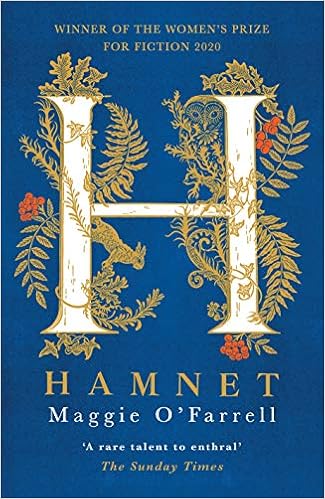
Hamnet: Winner of the Women’s Prize for Fiction 2020 Poetry, Drama & Criticism,History & Criticism,Literary Theory & Movements by Maggie O’Farrell with 384 pages.
- Details Hamnet: Winner of the Women’s Prize for Fiction 2020 Poetry, Drama & Criticism,History & Criticism,Literary Theory & Movements :
- Title : Hamnet: Winner of the Women’s Prize for Fiction 2020
Brand : Maggie O’Farrell
Category : Poetry, Drama & Criticism,History & Criticism,Literary Theory & Movements
ISBN : 1472223799
Page of number : 384 pages
Publisher : Tinder Press (31 Mar. 2020)
Language : English
Dimensions : 16.4 x 3.6 x 24.2 cm
- Usually Hamnet: Winner of the Women’s Prize for Fiction 2020 Poetry, Drama & Criticism,History & Criticism,Literary Theory & Movements are sold at a price of 14,69 to 20,00
Poetry, Drama & Criticism,History & Criticism,Literary Theory & Movements Hamnet: Winner of the Women’s Prize for Fiction 2020 by Maggie O’Farrell WINNER OF THE 2020 WOMEN’S PRIZE FOR FICTION – THE SUNDAY TIMES BESTSELLERSHORTLISTED AN POST BOOK AWARDS IRISH NOVEL OF THE YEAR’Richly sensuous… something special’ The Sunday Times‘A thing of shimmering wonder’ David MitchellTWO EXTRAORDINARY PEOPLE. A LOVE THAT DRAWS THEM TOGETHER. A LOSS THAT THREATENS TO TEAR THEM APART.On a summer’s day in 1596, a young girl in Stratford-upon-Avon takes to her bed with a fever. Her twin brother, Hamnet, searches everywhere for help. Why is nobody at home? Their mother, Agnes, is over a mile away, in the garden where she grows medicinal herbs. Their father is working in London. Neither parent knows that one of the children will not survive the week.Hamnet is a novel inspired by the son of a famous playwright. It is a story of the bond between twins, and of a marriage pushed to the brink by grief. It is also the story of a kestrel and its mistress; flea that boards a ship in Alexandria; and a glovemaker’s son who flouts convention in pursuit of the woman he loves. Above all, it is a tender and unforgettable reimagining of a boy whose life has been all but forgotten, but whose name was given to one of the most celebrated plays ever written.
- This is the story of Agnes – pronounced “Anyis”, also written as Anne – a 16th-century farmer’s daughter, and her marriage to a younger man with few obvious prospects. They make an odd couple for their practical times: she’s a gifted herbalist with psychic abilities, more self-assured than a Tudor woman ought to be in public; he’s the downtrodden son of a bully, fascinated by language and given to wordy puns. Poetry was even less of a career option in those days than it is now.Married for love, Agnes pregnant, they move into an annex of his father’s home where they must share their daily lives with his extended family. Three years later Agnes, pregnant with twins, arranges for her husband to seek his fortunes in London. There he stays, visiting often. Despite their separation, the couple remain close until one of the twins, Hamnet, dies at 11 years old. Grief for their child strains the relationship to breaking point; they grow further apart until, four years later, he publishes his groundbreaking tragedy, “Hamlet”. There’s a very satisfying resolution.Will Shakespeare is never named. This may be because so very much has already been written about him, and so little about her and their children. Shakespeare left no documentation whatsoever about his personal life – it’s a mistake to assume his works are autobiographical and, if he kept diaries, they are lost. Most historians, being male and applying the values of their own times, have filled this void with unkind assumptions about Anne Hathaway. Nobody knows the truth: we are free to imagine alternatives based on historical context.Maggie O’Farrell weaves complex tapestries of short stories, interconnected across time and space, as experienced by each of their characters. Her outstanding strength is the inner lives of women who, for her, are intensely attuned to nature and emotions, with an almost magical ability to see beyond the physical. Her own daughter suffers an extreme allergy syndrome, forcing her to live with the possibility of losing her child at any moment, and she herself endured a childhood brain infection that has left her with neurological issues. The vulnerabilities and sensibilities in her semi-fictional women are everyday realities for this author.While I loved the book and was fully drawn into Agnes’s life – I read it in one very long sitting – I felt doubtful about some of it, especially the more ‘magical’ aspects. Every Tudor housewife was expected to be a competent herbalist, brewer, cheesemaker and more; there was no need to present Agnes’s skills as exceptional. They were, though, very superstitious times and a woman of her character would have been viewed as odd, even dangerous.For companion reading with a different approach, I can recommend Germaine Greer’s “Shakespeare’s Wife” – it was one of O’Farrell’s sources for factual background. If you aren’t so bothered about real events, this is a wonderful, mystical, emotional roller-coaster!
Where do you start a novel in which readers know the titular character is going to die? Maggie O’Farrell chose to begin as eleven-year-old Hamnet is running around town looking for his mother or a doctor or someone – anyone – to tell that his twin sister Judith is ill. She has fever and there are buboes on her neck, a telltale sign of the plague. He can’t find anyone to help so he lies down on the bed beside her. It’s a clever opening. Instantly we’re engaged in the drama.Then we go back to watch the early days of Hamnet’s parents’ courtship. There’s Agnes, the wise, unusual girl who owns a hawk, who understands the properties of herbs, and who can judge a person by gripping between their thumb and forefinger. And Will, the enigmatic Latin tutor who is enchanted by her. Both come from difficult family backgrounds. We can feel the attraction. We’re rooting for them.The writing is delicious. Fruits and flowers, textures and atmospheres are described in sensuous detail that enhances rather than detracts from the story. It’s a joy to read.Maggie O’Farrell never calls Agnes’s husband and Hamnet’s father by the name William Shakespeare. He is ‘the husband’. But of course the portrait of him and the description of his behaviour is informed by our knowledge of his plays and his reputation in history.I’ve read some reviews that criticise the portrayal of Agnes as a wise woman who can see into the future, claiming that this is an overused trope, but for me it is used in an original way. Agnes only has glimpses of what will happen; she doesn’t see the danger stalking her son. She can’t quite tell what her husband will become, although she knows she has to let him pursue his career in London.The novel is compelling as a description of a mother losing a child, but it’s also a fascinating description of a marriage as both parents grieve separately, in their own ways. I’ve read and loved every single Maggie O’Farrell novel, as well as her non-fiction memoir I Am, I Am, so I knew I would love this too. If you haven’t read any of her work yet, Hamnet is a great place to start.
- Please like and share Poetry, Drama & Criticism,History & Criticism,Literary Theory & Movements by Maggie O’Farrell See also the latest posts on mar-kim.com

0 Comments